
Minab

Architecture; Beyond Consolation —for Peace and Life

International Design Competition for the Landscape and Memorial Space of the Minab Martyrs' Cemetery

Register Now
Open To Designers, Architects And Urban Planners
Participants
24.5 Billion IRR
Total Prize
Free
Entry Fee
17 November 2026
Submission Deadline
45d 14h 22m 56s
Registration Deadline
MINAB; WHY?

Minab: Against Oblivion

A catastrophe unfolds in an instant—and yet it never ends there. It goes on living, in the lives of those left to carry its aftermath. Everything that follows in time and every fate it silently rewrites remain part of the same catastrophe that is still unfolding. The attack by the United States on Minab—the martyrdom of innocent schoolchildren and townspeople and the merciless wounding of others within the school walls—left a wound that will never fully close in the hearts of those who bear it. Few undertakings in design are as fraught or as delicate as the making of memorials to war, to martyrs, to the dead: they reach beyond questions of form and function into the deeper terrain of collective memory, communal grief, and the resilience by which a people go on. It is for this reason that the architectural competition — as a mechanism for gathering ideas and drawing designers and artists into a shared act of remembrance — becomes not merely a professional method, but a social obligation. The International Design Competition for the Landscape and Memorial Space of the Minab Martyrs’ Cemetery forms part of a larger chain of efforts to honor the memory of the innocent martyrs of this crime, and it seeks to ensure that the truth of this event, the names and memory of its victims, the horror of the catastrophe, the guilt of those responsible, and our moral responsibility toward resistance, life, peace, and the future are never given over to oblivion.

February 28: The Catastrophe

On the morning of February 28, 2026, Minab, a city in southern Iran, sent its children off to school as it did every morning, unaware that, shortly after eleven o’clock, the city would be stained red with the shattered bodies of its own children, in an atrocity was complete in its cruelty: The missile bombing of Shajareh Tayyebeh Girls’ School and Rahpuyan-e Khalij-e Fars Boys’ School was carried out by the United States in a barrage of successive strikes. After the first strike, as principals and teachers gathered the students into what they believed to be the safest part of the school, a second missile—a two-stage missile—struck that very place, the school’s small prayer room, and The force of the blast tore away half of the two-story building. Seconds later, cries of grief rose from the city, where the bodies of innocent children lay beneath the rubble, while fragments of their bodies were scattered across the ground, their backpacks and books and small belongings strewn about, smeared with blood and dust. A man cried out, “Oh God — Doomsday has come! Oh God, whose child is this? Oh — oh God…” — and everyone began to run, while the cries of mothers tore through the air and a young woman collapsed onto a mound of earth at the school’s entrance. Rescue and excavation efforts began; dread spread through the city, and all of Iran held its breath as the wounded were transported to hospitals nearby and farther afield, while a single fear took root in the hearts of families: “Where is my child?” Slowly, the rubble was cleared; a sister was found beside her brother, students were found still held in their teachers’ arms as time passed, Minab’s beloved children were placed in black body bags, until most of the familiar faces bore only the names of the unidentified. The air was hot, and the makeshift morgue was too small, with row upon row of black bags laid side by side within it, and the search for any trace of the children pressed down on the shoulders of the grieving. Early reports said 168 had been martyred in this catastrophe. Those who could be identified were prepared for burial, while others remained behind for testing, and the burials continued for days afterward — after each new round of identification, and even four months later, further remains were laid to rest.

Minab: A Narrative of a Place Transformed

Some places are defined by what has been built upon them; others, by what has happened to them. Yet a rare few are born in a single moment of history—brought into being out of nothing by the event itself. On February 28, 2026, a plot of land in the northeastern corner of Minab’s main cemetery, was chosen as the resting place for the martyrs. The ground was no longer empty; it now carried grief, suffering, and compassion within it. The place acquired a new identity and character, its own narrative, and a new purpose.

Competition Aim and Program

The aim of the competition is to transform a 8,000-square-meter site within Minab main cemetery into a living memorial landscape, a cultural infrastructure in which consolation, resistance, the pursuit of peace, and the continuity of life coexist. This aim is to be realized through geometry and proportion, the composition of space, light and shadow, structures, forms, materials, color, texture, trees, plantings, and other natural elements. The intervention in the landscape, accordingly, is not concerned with luxury or monumentality. Its true purpose lies in architectural quality, together with the precise design of open and shared spaces and functions, and the establishment of a dialogue among place, emotion, and behavior.
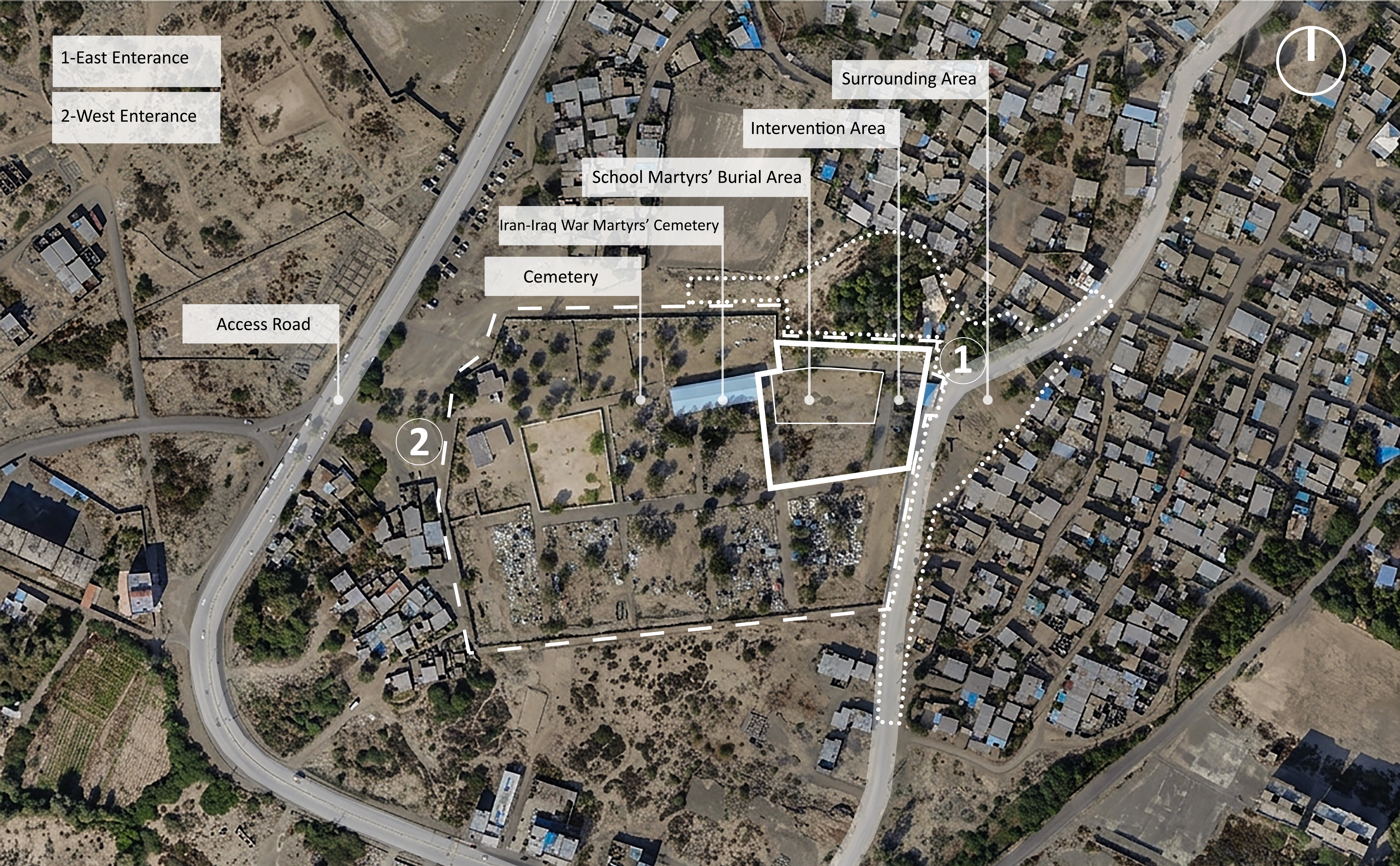
Site Location
Annotated aerial map of the competition site
Competition Theme

Architecture;Beyond Consolation — For Peace and Life

In response to the competition’s guiding question, four foundational concepts are proposed as the conceptual framework for design: Remembrance, Consolation, Empathy, and Peace and Life. These concepts are not independent objectives, nor sequential stages; rather, they constitute complementary dimensions of the memorial landscape, to be expressed as an integrated whole across the design. Together, the four concepts articulate the range of ways in which individuals and society confront catastrophe — from honoring the past to building the future.

• Remembrance: Safeguarding the truth of what occurred and preserving the memory of the martyrs for future generations.

• Consolation: Providing a space for presence, mourning, and reflection, and for easing the suffering of survivors and the bereaved.

• Empathy: Strengthening human bonds and transforming individual suffering into a shared experience of compassion, respect, and social responsibility.

• Peace and Life: Opening a horizon toward the future — the passage from grief to moral responsibility: condemning violence and resisting it, sustaining public advocacy, pursuing legal accountability, seeking justice, and working to prevent the recurrence of such crimes.

Calendar

Key Dates

Call for Entries
23 August 2026
Closing Date for Registration
27 October 2026
Closing Date for Questions & Clarifications
29 October 2026
Submission Opens
12 November 2026
Closing Date for Submission
17 November 2026
Announcement of the Winners
5 December 2026*
Prize Distribution
By 11 December 2026
Prizes

CompetitionPrizes

1st Place
12 Billion Rials
2nd Place
6 Billion Rials
3rd Place
3 Billion Rials
4th Place
2 Billion Rials
5th Place
1.5 Billion Rials
+
8
Special Mentions
Get the Documents

CompetitionMaterials

Competition Guide
Technical Drawings & Forms
Download →
Reference Materials
Download →
Site Photos & Videos
Download →
Minab Images & Media
Download →
Supplementary Documents

Jury

To Be Announced Soon

Jury Member
Architect | University Professor
Jury Member
Architect | University Professor
Jury Member
Architect | University Professor
Jury Member
Architect | University Professor
Jury Member
Architect | University Professor
Jury Member
Architect | University Professor
Jury Member
Architect | University Professor
Eligibility

Who can participate?

Participation in the competition is open to individuals holding a bachelor’s degree in architecture, urban design, or a related field, as well as to professional architecture and urban design firms and qualified engineering consulting companies.

Participation may be either individual or as part of a group.

In the case of group participation, each group must designate an official representative who holds a bachelor’s degree or higher in architecture, urban design, or a related field. The official representative will be responsible for registration, official correspondence, document submission, and all communications with the organizer.

Participants who do not meet the eligibility requirements for individual participation—including students in architecture, urban design, and related fields, as well as artists, designers, and specialists from other disciplines—are encouraged to participate as members of interdisciplinary teams. Each such team must designate an official representative who holds a bachelor’s degree or higher in architecture, urban design, or a related field.

Given the cultural, social, and human dimensions of this competition, interdisciplinary collaboration is strongly encouraged.

Register Now →

Frequently Asked Questions

The aim of the competition is to propose a design that enhances the spatial quality and landscape of a section of Minab’s main cemetery— including the martyrs’ burial area and its surrounding spaces — and to create a cultural, commemorative and collective environment. The proposed space should, while honoring and preserving the memory of the martyrs, provide opportunities for gathering, pause, mourning, dialogue, contemplation and tranquility, while allowing for the continuity of everyday life.

Participation in the competition is open to individuals holding a bachelor’s degree in architecture, urban design, or a related field, as well as to professional architecture and urban design firms and qualified engineering consulting companies. Participation may be either individual or as part of a group. In the case of group participation, each group must designate an official representative who holds a bachelor’s degree or higher in architecture, urban design, or a related field.

Yes. Participants who do not meet the eligibility requirements for individual participation—including students in architecture, urban design, and related fields, as well as artists, designers, and specialists from other disciplines—are encouraged to participate as members of interdisciplinary teams. Each such team must designate an official representative who holds a bachelor’s degree or higher in architecture, urban design, or a related field.

No. Registration and participation in the competition are entirely free of charge, and no fee will be charged to participants.

No. Each participant or team may submit only one design.

The competition site forms part of Minab’s main cemetery, Behesht-e Zahra. It includes the martyrs’ burial area and part of the surrounding spaces. Drawings, basic information and other materials required for the design process are available for download in the “Competition Materials” section of the official competition website.

No alteration or relocation of any grave or burial site is permitted. However, changes to roads and pathways are permitted, provided that they comply with the design program and considerations set out in the “Competition Brief”.

The complete list of documents and materials required for submission is set out in Clause 17 of the “Competition Brief”. Participants are required to prepare and submit their entries in accordance with the rules, requirements and formats specified in the “Competition Brief”.

All submitted documents and materials must be presented either bilingually in Persian and English or in English only.

Entries may be submitted only electronically (no physical submission) through the participants’ dedicated dashboard on the official competition website. Participants must upload their submissions within the stated deadline and in accordance with the procedure, rules and requirements set out in the “Competition Brief”.

The organizer will first conduct an initial review of the submitted proposals to verify their compliance with the competition rules and requirements. Proposals that meet the requirements for proceeding to the judging stage will then be evaluated by the Jury. The evaluation will be based on a set of announced criteria. The main evaluation criteria are set out in Clause 10 of the “Competition Brief”.

The results of the competition will be announced on the official competition website and other architectural competition platforms and websites.

Participants may submit questions regarding the competition only by email to contact@minabmemorial.ir, no later than 29 October 2026. Questions and answers that may be useful to other participants will also be compiled into an official Frequently Asked Questions (FAQ) document and published on the official competition website.

Invitation

Participants from around the world are invited to imagine a memorial landscape that honors the martyrs of Minab School, targeted in the U.S. missile attack of 28 February 2026. The proposal should transform a site of tragedy into an enduring public landscape where remembrance, consolation, reflection, and everyday life can coexist with dignity.

At the heart of the competition lies a simple yet profound question: What is the responsibility of architecture in the face of such a catastrophe?

We invite you to take part in this competition – not only as a professional challenge, but as a shared moral and human responsibility.

Register Now

Organizer

Astan Quds Razavi

in collaboration with Hormozgan provincial government and Minab municipality

Astan Quds Razavi